

🥇 Real Estate Teams: The Leverage and the Liability
- CCK

- Jun 23
- 4 min read
Teams are the fastest way to scale, and the fastest way to create a compliance mess.
Everything below relates to teams within a brokerage and not a brokerage that operates with "team" designations or branding for the overall brokerage. It also only relates to Georgia when discussing compliance considerations.
There’s a reason agents build teams. Done right, a team lets you stop doing the parts of the job you hate, lean into what you’re actually great at, and serve more clients than you could alone. NAR reported in 2023 that team agents average roughly 2.5x more transactions per agent than solo practitioners. Agents join for lead overflow, specialization, work-life balance, and income leverage. All legitimate; all valuable.
But here’s the catch: a team is not a brokerage, and a team leader is not the qualifying or compliance or managing broker (even if they are a broker). Everything good about a team (shared leads, shared systems, shared clients) sits on top of a legal structure that doesn’t change just because you put a brand name on it. When that structure isn’t handled deliberately, the same things that make a team powerful become the things that get agents and brokers in front of the Commission.
Let’s look at both sides.
The value: what a healthy team actually delivers. A strong team has clear written role definitions for every member, regular meetings with real follow-through, a defined onboarding and training process, and transparent commission math.
Things to watch out for: Most team disputes and complaints trace back to the same handful of gaps.
Verbal agreements. A team built on a handshake is a lawsuit waiting to happen. Commission splits, lead ownership, who pays for any lead gen services and the CRM, what happens to clients and pending files when someone leaves: if it isn’t in writing, the only thing guaranteed is the fight that will ensue. Settle it while everyone still likes each other. Think of your written agreements like a co-habitation agreement and a prenup. It is much easier to work through the what-ifs when everyone is excited about the new relationship. Everything is hypothetical.
The broker left out of the loop. Teams operate within a brokerage, and the broker is legally responsible for all licensed activity regardless of team brand. A team leader can manage operations but cannot supervise licensed activity. “The team told me to” is never a defense. A GREC complaint still names the agent and possibly the broker if there is a claim that there was failure to supervise.
Branding that buries the brokerage. GREC advertising rules require the brokerage name on every client-facing touchpoint: yard signs, websites, social bios, email signatures, business cards. A team name in big print with the brokerage in tiny print (or absent) is one of the top complaint categories, and the evidence sits in public for any competitor to report.
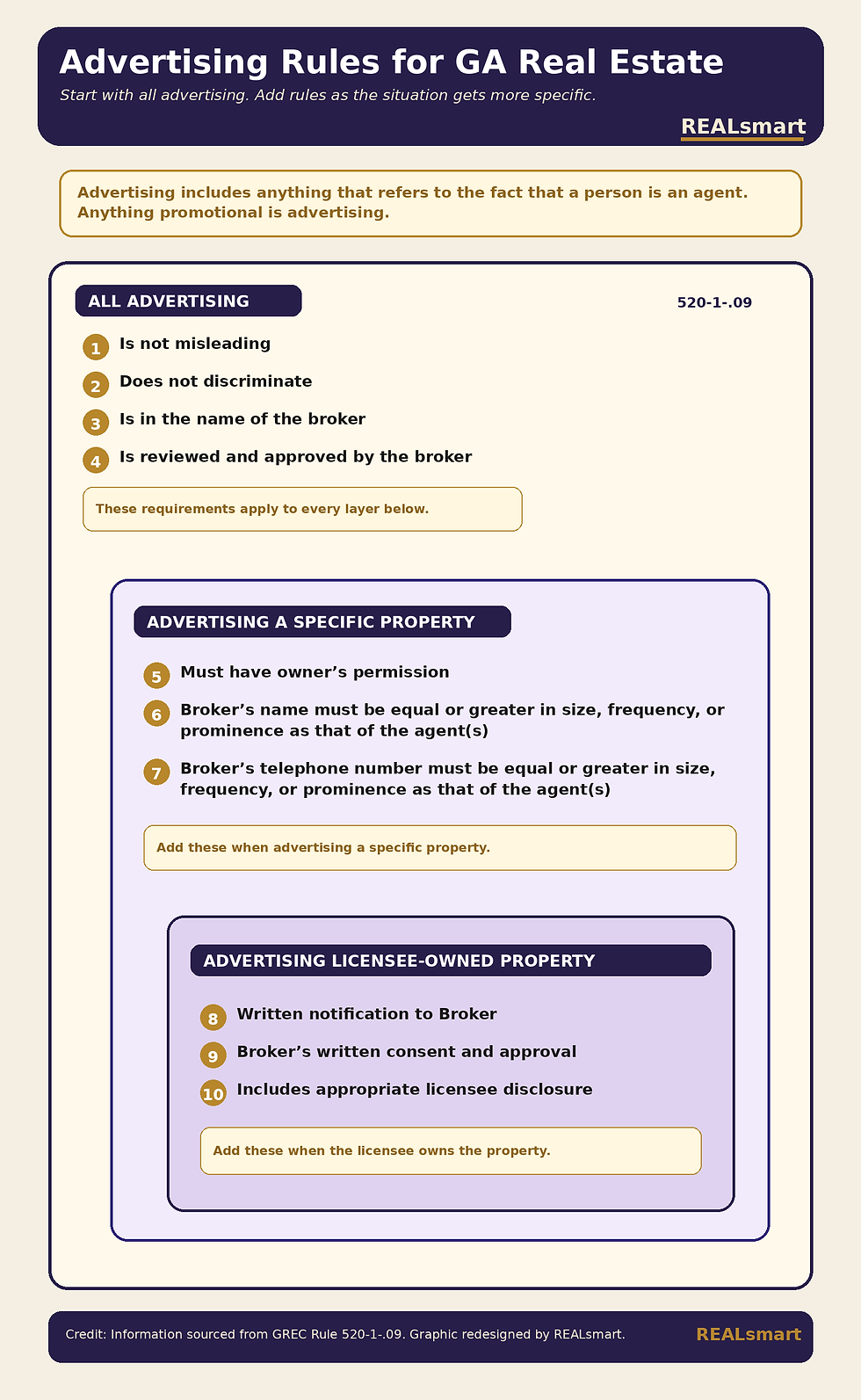
What brokerage names can be / must be used? For a better understanding of what I am about to say, look at the GREC search tool for agents and companies. There is a primary brokerage firm name registered with the real estate commission. This is rarely the branded name they use. It is usually the legal LLC company name. The advertising friendly brand names for the brokerage are often listed as DBAs (Doing Business As) in the GREC system. They include the primary brand name and specialty names that have descriptors like luxury or commercial added. Individual team names can be added as alternative DBAs that would allow the team to use their personally branded name as they compliant advertising name.
Requirement and Practical Tip for Registering the Team Name as a DBA with GREC:
Broker agreement is required since they will have to add it with GREC
Brokerage policies and procedures should list the approved DBAs that can be used without specific broker permission to prevent a non-team member within the brokerage from also using the name
The team “signing” engagements. A team is not a licensee and cannot sign a brokerage engagement agreement or a contract. The licensed individual signs, with their name and license number, and the brokerage is identified, not just the team brand. The team markets the service; a licensed person delivers it and is accountable for it.
The dual/designated agency issue. When two teammates separately represent the buyer and seller, that technically meets the definition of designated agency. The real question is whether the team can actually keep confidential information separated.
Designated agency requires representing your client to the exclusion of the other client. The two agents can only share anything about the transaction with the Broker, not teammates and not the team leader. With shared CRM notes, group chats, voicemails, and team huddles, that wall may not exist in practice. Brokerages should set policy on this before it shows up as a complaint.
What a good team looks like:
1. Get the agreement in writing and reviewed by counsel. Cover commission splits, lead and client ownership, expense allocation, non-solicitation, exit procedures, technology and access revocation, and dispute resolution. If you’re joining a team, never sign an agreement you do not fully understand and seriously consider having own attorney reviewing it if you.
2. Bring your broker in as a partner, not an afterthought. Confirm your brokerage office policy expressly addresses team structure, supervision, and advertising. If you don’t feel comfortable having that conversation with your broker, that itself is worth some consideration.
(Georgia note: GREC has not issued team-specific rules, so existing license law, BRRETA, and advertising rules govern.)
Building_a_Compliant_Team_Checklist.pdf is a box-by-box audit covering licensing, written agreements, supervision, advertising, lead ownership, and departure protocol.
3. Audit your branding and your separation. Put “(Team Name)(Brokerage Name)” on every channel, and map every shared system to spot where a same-team deal could collapse the designated-agency wall.
🎧 Don’t Miss This Week’s Episode
If this topic matters to your business, you’ll want to listen to a closing attorney and REALTOR® break it down.
Cheryl Conner King
Founder & Instructor
REALsmart Real Estate School
Attorney | REALTOR® | CE Instructor
📍 Based in Georgia | Teaching Statewide


Comments